Loading cart contents...
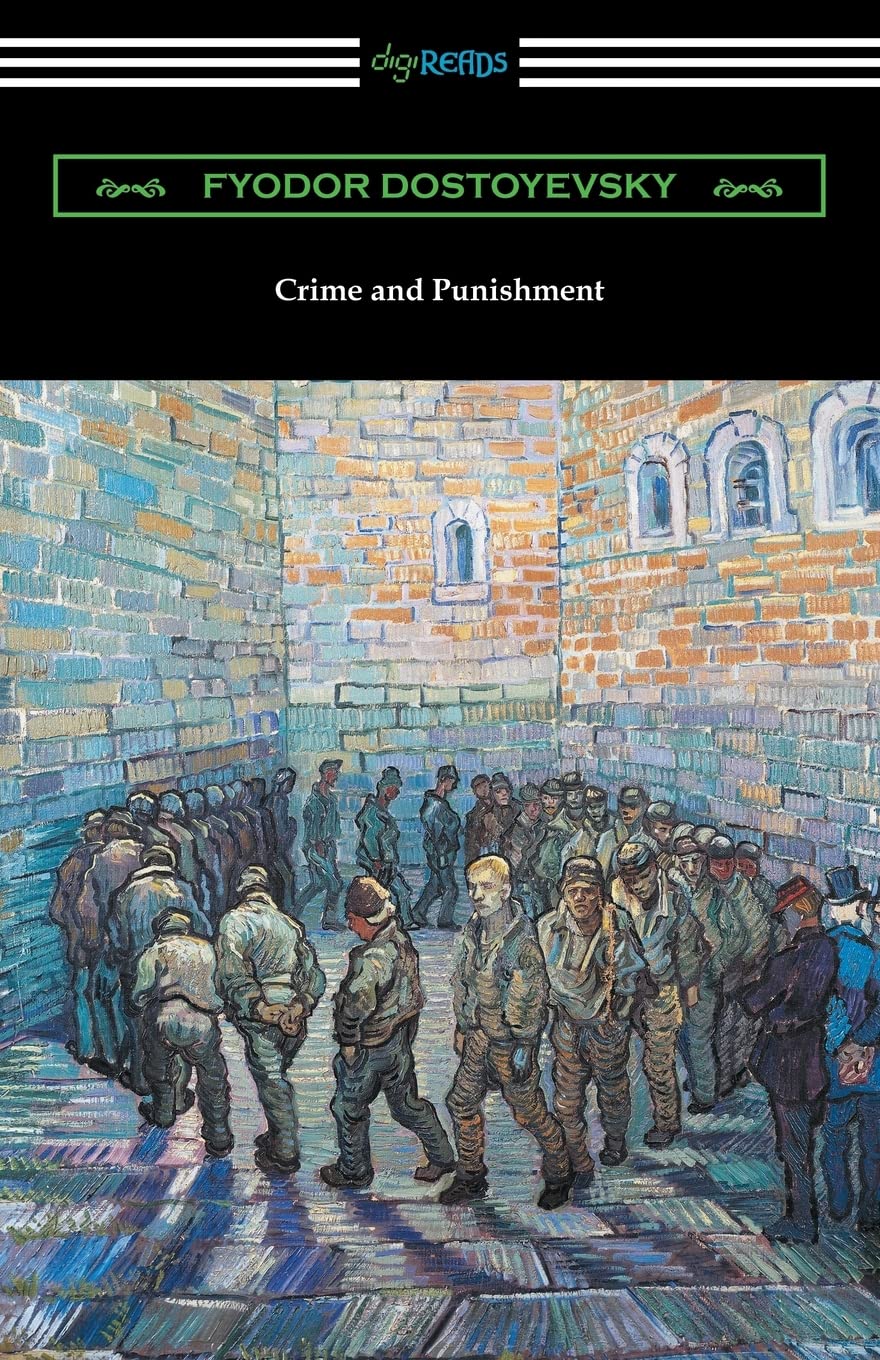
Crime and Punishment (Translated by Constance Garnett with an Introduction by Nathan B. Fagin)
20.00 JOD
Please allow 2 – 5 weeks for delivery of this item
Description
Raskolnikov is an impoverished former student living in Saint Petersburg, Russia who feels compelled to rob and murder Alyona Ivanovna, an elderly pawn broker and money lender. After much deliberation the young man sneaks into her apartment and commits the murder. In the chaos of the crime Raskolnikov fails to steal anything of real value, the primary purpose of his actions to begin with. In the period that follows Raskolnikov is racked with guilt over the crime that he has committed and begins to worry excessively about being discovered. His guilt begins to manifest itself in physical ways. He falls into a feverish state and his actions grow increasingly strange almost as if he subconsciously wishes to be discovered. As suspicion begins to mount towards him, he is ultimately faced with the decision as to how he can atone for the heinous crime that he has committed, for it is only through this atonement that he may achieve some psychological relief. As is common with Dostoyevsky’s work, the author brilliantly explores the psychology of his characters, providing the reader with a deeper understanding of the motivations and conflicts that are central to the human condition. First published in 1866, “Crime and Punishment” is one of Fyodor Dostoyevsky’s most famous novels, and to this day is regarded as one of the true masterpieces of world literature. This edition is printed on premium acid-free paper, is translated by Constance Garnett, and includes an Introduction by Nathan B. Fagin.
Additional information
| Weight | 0.54 kg |
|---|---|
| Dimensions | 2.41 × 13.97 × 21.59 cm |
| Publication City/Country | USA |
| ISBN 10 | 1420955098 |
| About The Author | Fyodor Mikhailovich Dostoyevsky (/ˌdɒstəˈjɛfski, ˌdʌs-/; Russian: Фёдор Миха́йлович Достое́вский; IPA: [ˈfʲɵdər mʲɪˈxajləvʲɪtɕ dəstɐˈjɛfskʲɪj]; 11 November 1821 – 9 February 1881), sometimes transliterated Dostoevsky, was a Russian novelist, short story writer, essayist, journalist and philosopher. Dostoyevsky's literary works explore human psychology in the troubled political, social, and spiritual atmosphere of 19th-century Russia. Many of his works are marked by a preoccupation with Christianity, explored through the prism of the individual confronted with life's hardships and beauty. He began writing in his 20s, and his first novel, Poor Folk, was published in 1846 when he was 25. His major works include Crime and Punishment (1866), The Idiot (1869), Demons (1872) and The Brothers Karamazov (1880). His output consists of 11 novels, three novellas, 17 short novels and numerous other works. Many literary critics rate him as one of the greatest psychologists in world literature. His 1864 novella Notes from Underground is considered to be one of the first works of existentialist literature. Born in Moscow in 1821, Dostoyevsky was introduced to literature at an early age through fairy tales and legends, and through books by Russian and foreign authors. His mother died in 1837, when he was 15, and around the same time he left school to enter the Nikolayev Military Engineering Institute. After graduating, he worked as an engineer and briefly enjoyed a lavish lifestyle, translating books to earn extra money. In the mid-1840s he wrote his first novel, Poor Folk, which gained him entry into St. Petersburg's literary circles. In the following years, Dostoyevsky worked as a journalist, publishing and editing several magazines of his own and later A Writer's Diary, a collection of his writings. He began to travel around western Europe and developed a gambling addiction, which led to financial hardship. For a time, he had to beg for money, but he eventually became one of the most widely read and highly regarded Russian writers. His books have been translated into more than 170 languages. Dostoyevsky influenced a multitude of writers and philosophers, from Anton Chekhov and Ernest Hemingway to Friedrich Nietzsche and Jean-Paul Sartre. Bio from Wikipedia, the free encyclopedia. |
Related products
![]()
On backorder 2-5 Weeks to Arrive
![]()
On backorder 2-5 Weeks to Arrive
10.71 JOD![]()
Low stock
![]()
On backorder 2-5 Weeks to Arrive
15.99 JOD