
Loading cart contents...
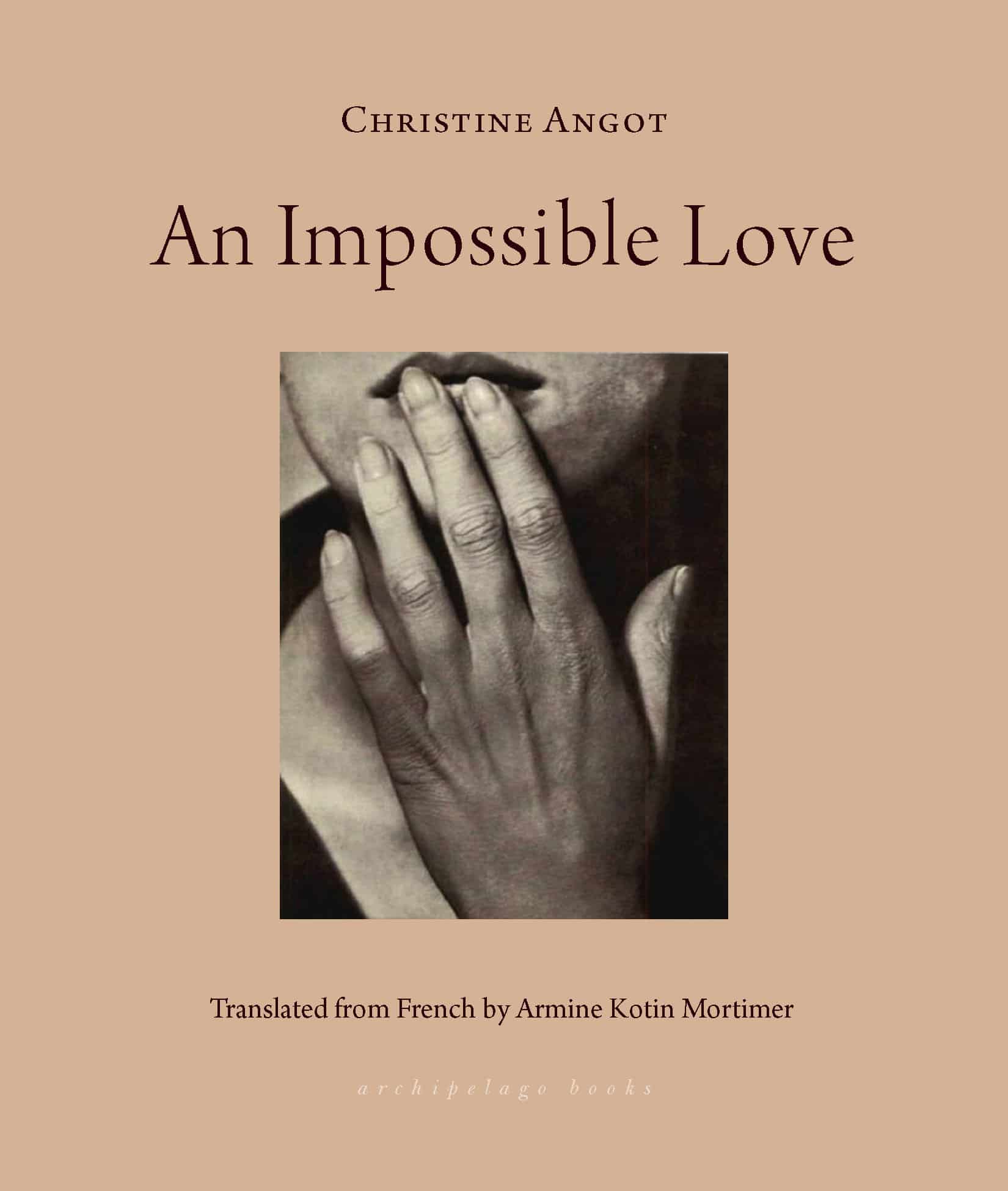
Description
An agonizing turbulence lies just beneath the surface of this skillfully wrought novel by the French phenom who caused a sensation with the publication of her novel Incest.Reaching back into a world before she was born, Christine Angot describes the inevitable encounter of two young people at a dance in the early 1950s: Rachel and Pierre, her mother and father. Their love is acute. It twists around Pierre’s decisive judgments about class, nationalism, and beauty, and winds its way towards dissolution and Christine’s own birth. Though it’s Pierre whose ideas are most often voiced, it’s Rachel who slowly comes into view, her determination and patience forming a radiant, enigmatic disposition. Equal parts subtle and suspenseful, An Impossible Love is an unwavering advance toward a brutal sequence of events that mars both Christine’s and Rachel’s lives. Angot the author carves Angot the narrator out of this corrosive element, exposing an unmendable rupture, and at the same time offering a portrait of a striking, ineradicable bond between mother and daughter.
Additional information
| Weight | 0.23 kg |
|---|---|
| Dimensions | 1.43 × 13.87 × 16.51 cm |
| PubliCanadanadation City/Country | USA |
| ISBN 10 | 1953861040 |
| About The Author | CHRISTINE ANGOT is one of the most controversial authors writing today in France. Since the 1999 publication of Incest, Angot has remained at the center of public debate and has continued to push the boundaries of what society allows an author to express. Born in 1958 in Châteauroux, Angot studied law at the University of Reims and began writing at the age of 25. Her literary works have received prizes including the Prix France Culture in 2005 (for Les Désaxés and Une partie du cœur), the Prix Flore in 2006 (for Rendez-vous) and the Prix Sade in 2012 (for Une semaine de vacances), which she refused on the grounds that the theme of the prize did not correspond to the book she had written. In 2015 she won the Prix Décembre for her novel Un Amour impossible. Angot is now also a commentator on the television show On n'est pas couché.ARMINE KOTIN MORTIMER is the translator of Philippe Sollers's Mysterious Mozart (University of Illinois Press, 2010) and his Casanova the Irresistible (Illinois, 2016), as well as Julia Kristeva's The Enchanted Clock (Columbia University Press, 2017). Her long career as a professor of French literature occasioned many scholarly books and articles, as well as recognition by the French government with the Palmes Académiques in 2009. |
"The most recently translated autofiction by controversial French literary phenomenon Angot brings her unflinching intelligence to a terrible childhood trauma . . . Described without overstatement or sensationalism, raw and honest, [Rachel and Christine's] experience rings brutally true . . . Disturbing, powerful, a deeply personal story that is also searingly political."–Kirkus Reviews (starred review)"An illuminating account of a mother and daughter's complicated love." –- Publishers Weekly"Christine Angot is one of the bravest women writing in France today, and Armine Kotin Mortimer’s English translation of this novel is lucid and powerful. Incest was among the most difficult books I’ve ever read. Shockingly raw, erratic, poetic, and chaotic, it put you in the center of the author’s self-loathing. But the restraint and emotional range displayed in An Impossible Love makes this book a more painful story." –Amanda Holmes Duffy, Washington Independent Review of Books "An Impossible Love immerses the reader in both the solipsism of the two lovers and the wider world of French society in the 1950s . . . Angot has suggested that there is no distinction between real and fake, nor true and false in literary writing. There is only ‘alive prose’ and ‘dead prose’. There are words that remain on the page, and those that somehow manage to transcend themselves. Angot’s writing lives." –Alice Blackhurst, New Left Review"I was enthralled by An Impossible Love from the first page to the last. Christine Angot brilliantly traces the minute fluctuations of emotion in her trio of characters, as well as the evasions, omissions and deceptions implicit in every kind of love. A daring and impressive performance."–Lynne Sharon Schwartz"A compelling chimera . . . A dissection of how power can be a potent aphrodisiac to those who wield it, a poison to those on its receiving end . . . Angot’s method is cunning and confrontational, delivering a shocking sucker punch to any of us that might be tiring of autofiction."–Heavy Feather Review"[An Impossible Love] has a formal, dispassionate style of language. Towards the end, this yields to an emotional depth when mother and daughter . . . reach a point of clarity and concord about the person who ruined their lives." –Declan O'Driscoll, Irish TimesPraise for Incest "A formally daring and passionate performance of the depths of human self-loathing, and the sufferings of attachment. It cut deep inside me with its truths. In every moment of reading it, I both wanted to keep reading it and wanted to write. I don't think I will ever forget this book." — Sheila Heti "A maximalist in the art of emotion, Angot unmasks with frightening precision the roiling heart and the sharp edges of lust, loathing, and scorn lodged within love's fossil record. This is a book that points you toward the subterranean roots of your own emotions, the intricacies and murk we cover up in the name of normal daily operations." — Alexandra Kleeman "At times reminiscent of playwright Sarah Kane, particularly in her incantatory free associations . . . Incest is remarkably prescient. Christine Angot pinpoints how technology antagonizes mental health; how a lack of immediate reply can give the obsessive mind no room to breath." — Rebecca Watson, The Times Literary Supplement"A sensation in France, [Incest is a] novel in the form of a wild confession of a life filled with trauma." — The New York Times"Given Angot's antagonism toward conventional syntax, the English translation, by Tess Lewis, is a feat of perspicuity… When "L'Inceste" was first published, an interviewer asked Angot what she hoped to achieve. "My ambition is to be unmanageable," she said. "That people swallow me and at the same time cannot digest me." — H. C. Wilentz, The New Yorker"Angot's writing reclaims the confession as a radical act–spiritual, even… At its core, Incest is a true testament to the subversive power of literature, in that it transmutes the violation of incest into connection with the reader." — Elizabeth Baird, The Millions"Christine Angot, who despises proper sentiment, has a fascinating, exhilarating, dazzling sensitivity." — Yann Moix, Le Figaro littéraire | |
| Excerpt From Book | My father and mother met in Châteauroux near the Avenuede la Gare in the cafeteria she frequented, at twenty-six she hadalready been with the Sécurité Sociale for several years. Shestarted working at seventeen as a secretary in a garage; he, afterlengthy studies, had his first job at thirty. He was a translator atthe American base in La Martinerie. Between Châteauroux andLevroux, the Americans had built a housing development onseveral hectares with little one-story houses surrounded by gardenswithout fences, in which the families of the military lived.The base had been allocated to the Americans through the MarshallPlan, at the beginning of the fifties. A few trees had beenplanted, but when you went by on the highway, you could see amultitude of red hip roofs scattered across a broad empty plain.Inside what was really a little village, wide paved streets allowedthe inhabitants to travel in their cars, slowly, between the housesand the school, the offices, and the runway at the base. He hadbeen hired there after his military service, he didn’t intend tostay. It was temporary. His father, who was a director at Michelin,wanted to persuade him to work for the Green Guide, but hereadily saw himself having a career as a researcher in linguisticsor in academics. His family had lived in Paris for generations, inthe seventeenth arrondissement, near Parc Monceau; they camefrom Normandy. In Paris, many had been doctors. They werecurious about the world, they had a passion for oysters.He invited her for coffee. And a few days afterwards for a dance.That evening she was supposed to go to a so-called “social ball”with a girlfriend. Social balls, organized by a group or an associationthat rented an orchestra and a large hall (distinct from thedance halls frequented by Americans and prostitutes), attractedthe young people in Châteauroux. This one took place in a largeexposition hall on the Déols highway, Hidien Park. My fatherdidn’t usually attend.“Oh, I don’t go to that kind of thing … We’ll go out anotherevening. I’m going to stay home. I have work …”She went with her friend Nicole and Nicole’s cousin. The eveninghad already gone on for quite a long time when she saw himin the distance coming through the crowd. He approached theirtable. He invited her to dance, she got up, she was wearing awhite skirt with a wide belt. They made their way toward thedance floor, he smiled as they arrived on the parquet floor, shewas ready to slip into his arms, he took her hand to guide her andspin her around among the dancers. At that moment the orchestrabegan playing the first measures of “Our story is a story oflove.”It was a song you heard everywhere. Dalida had inauguratedit. She would sing it with intensity, mixing the tragic with thebanal. Her accent gave a roundness to the words and stretchedthem out at the same time, her deep voice enveloped the soundsand gave them a particular substance, there was somethinghaunting about the whole thing. Accompanied by the orchestra,the singer imitated Dalida’s original interpretation, the better toheighten the emotion.Ourr storrry is a storrry of lo-o-oveEterrrnalll and banalll it brrrings each dayAll the good all the bad.They weren’t talking to each other.It’s the well-known storrry …The dance floor was crowded, it was a very popular song.Those who lo-o-ove each other play together, I knowMy complaaaint is the plaaaint of two heartsIt’s a novel like so many others, which could be yourrrsIt’s the flame that enflames without burningIt’s the dreeeam you dreeeam without sleepingMy storrry, it’s a storrry … of … a … lo-o-ove.They were silent during the whole song.With the hourrr when you embrace, the one when you sayfarrrewellWith the evenings of anguish and the marrrvelous mornings …And tragic or very deep, it’s the only storrry in the worrrldThat will never end.It’s the storrry of a love …They weren’t looking at each other.But naïve or very deep, it’s the only storrry in the worrrld,Our story is the storrry … of a lo-o-ove.The song came to an end, they separated. And they went back totheir table through the crowd. She introduced Nicole and hercousin to him. |
Only logged in customers who have purchased this product may leave a review.
Related products
![]()
On backorder 2-5 Weeks to Arrive
Add to Gift Registry9.99 JOD![]()
On backorder 2-5 Weeks to Arrive
Add to Gift Registry16.99 JOD![]()
Low stock
Add to Gift Registry![]()
On backorder 2-5 Weeks to Arrive
Add to Gift Registry


Reviews
There are no reviews yet.