
Loading cart contents...
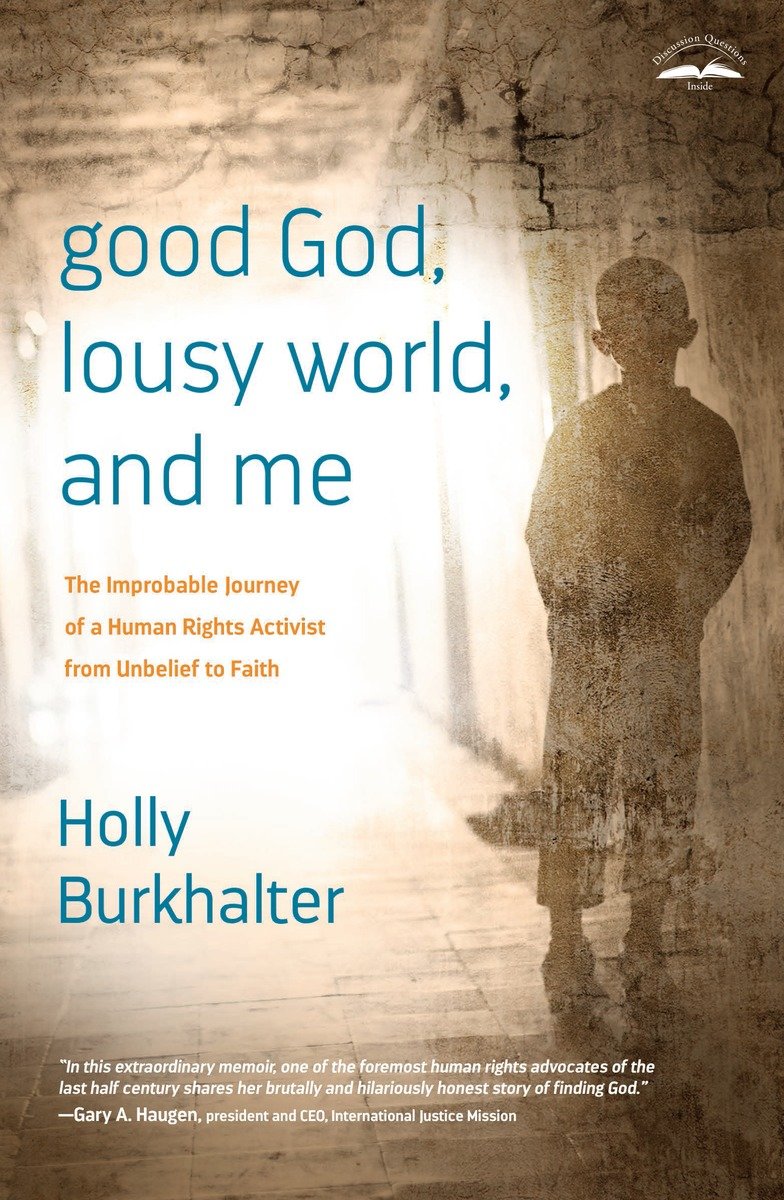
Good God, Lousy World, and Me: The Improbable Journey of a Human Rights Activist from Unbelief to Faith
16.00 JOD
Please allow 2 – 5 weeks for delivery of this item
Description
“In this extraordinary memoir, one of the foremost human rights advocates of the last half century shares her brutally and hilariously honest story of finding God.” —Gary A. Haugen, president and CEO, International Justice Mission For years, Holly Burkhalter was a heartbroken idealist working on the front lines of change around the world—a witness to the brutalities of genocide, sex trafficking, rape, slavery, greed and injustice. Throughout her career she found herself angrily, sometimes hilariously at odds with a God who seemed distant at best and tyrannical at worst. Until the day she found herself drawn into a community of fellow activists who loved, worshiped, and served another God altogether—a God who hated injustice, too. And who had a plan for combating it. Us. It was the greatest, most radiant surprise of her life. Today Holly engages deeply with the questions that kept her from faith for most of her adult life: How could a good God allow brutality, mental illness, and AIDS? Why does God seem indifferent when we are in great need? What is our part in pushing back the darkness? Through riveting stories from her life, she wrestles these questions to the ground. Sometimes she wins. Sometimes the questions do. Either way, Good God, Lousy World & Me will transform your understanding of God’s presence and purpose—and ours—in a broken world.Now includes a small group discussion guide.
Additional information
| Weight | 0.18 kg |
|---|---|
| Dimensions | 1.35 × 13.44 × 20.07 cm |
| PubliCanadation City/Country | USA |
| ISBN 10 | 1601425104 |
| About The Author | Holly Burkhalter is a leading international human rights advocate with a thirty-year career in Washington, DC. Currently, she is vice president for Government Relations and Advocacy for International Justice Mission. She and her husband, John Fitzpatrick, live with their two daughters and one large dog in a small house on Capitol Hill. |
Praise for Good God, Lousy World, and Me“Holly Burkhalter has been a voice of conscience in Washington for many, many years. She has written some of the most powerful and pointed op-eds the Post has published. She’s a gifted writer with a big heart and a unique, compassionate take on the human condition.”—Fred Hiatt of The Washington Post“Holly’s story, from a distance, is absolutely fascinating—one of the world’s top experts in human rights turns out to be a person of deep Christian commitments. But her story up close is even better: by turns laugh-out-loud funny, poignant, wrenching, and hopeful. I think this is a voice the wider world needs to hear.”—Andy Crouch, author of Culture Making: Recovering Our Creative Calling and executive editor of Christianity Today“Good God, Lousy World, and Me is what happens when a passion for justice is joined to a seeking spirit. Holly Burkhalter’s work for a world that cherishes all people is undergirded by her faith in a God who does likewise. This is Christianity as we wish it could be.”—Phillip Gulley, author of Living the Quaker Way“Good God, Lousy World, and Me is a desperately needed, encouraging read, helping us see that we don’t need everything figured out before we act on behalf of the poor, marginalized, and oppressed. Instead Holly takes us on a journey where true strength shows up through our humanity, where our daily burdens and spiritual questioning make faith the miracle it truly is. With a blunt, challenging, funny, and intimate recount of personal experiences, Holly punches some of the taboos left in today’s society. For those of us who’ve questioned God after witnessing, hearing, or experiencing injustice or those who’ve quietly suffered with mental illness, Holly’s words rally the soul and challenge the myth that one must accept neat answers to life’s darkest moments before professing faith and declaring war on injustice.”—Steve Martin, CEO of Love146“Anything written by Holly Burkhalter is worth reading, and her book is no exception.”—Jody Williams, winner of the 1997 Nobel Peace Prize“Holly’s story is a journey from unbelief to the unbelievably critical work of justice for the poor and marginalized in the name of God. It’s a powerful story from an unforgettable pilgrim.—Joel Edwards, director of Micah Challenge International“In this extraordinary memoir of grace, one of the foremost human rights advocates of the last half century shares her brutally and hilariously honest story of finding God on one of the most unlikely, irreverent, and utterly beautiful pilgrimages through life as it actually is. Hers will become an iconic story of spiritual reflection in our era—a chronicle of the deepest human yearning amidst shattering pain, everyday redemption, and the irrepressible love of her Maker.”—Gary A. Haugen, president & CEO of International Justice Mission“Face to face with atrocities that call into question both the existence of God and ‘is there any human left in humanity,’ Holly comes out swinging. Intermittently humble and fierce, she dares to plumb the depths of faith and slowly, tenderly finds God. Living between winsome and raw, which is not for the faint of heart, there are tungsten strands of emerging faith. This book will leave you exhausted and exhilarated, both of which are good for expanding the soul.”—Nancy Ortberg, author of Looking for God | |
| Excerpt From Book | Tires on a JeepIt was the year 1990. I was in West Africa and not happy about it. Thousands of Liberians had been forcibly displaced from their country by marauding army and rebel forces. Fleeing families were living in squalor, drinkingand washing in filthy water, and eating whatever scraps poor villagers could share.My assignment was to interview these refugees from hell and report on the events that had put them to flight.In a quiet voice, a man described to me a fellow villager being slowly cut to death by teenage boys wearing women’swigs. A young woman explained that she’d survived an attack on her village by hiding in the bush, from where she watched armed men wrap her mother in a gasoline-soaked mattress and set it aflame. A university professor who had fled with only the clothes he wore—a business suit—wept while we spoke, bizarrely, of the indignity of eating with his hands. Having lost everything, he yearned for a fork.I took notes, filling pages of my notebook with hideous, degrading, pitiful stories, one after another. Then I rejoinedmy fellow travelers, a group of American and French relief experts, for a jouncing Jeep ride through the bush back to our hostel in town.When we arrived, one of my colleagues, an Ethiopian evangelical woman, broke into joyful prayer. She thanked theLord for our safe arrival and for sparing our overland vehicle a flat tire.I thought I’d vomit. I had literally overdosed on malaria medicine—a French doctor in the refugee camp told me, mistakenly, to double my dosage, so I did. Antimalarial drugs in those days caused hallucinations, and I was having them. I hadn’t eaten or slept for three days, and I was trembling with revulsion and fear from the stories I’d heard. Praising God for our spectacular privileges, right down to our intact tires, in the face of the hunger and trauma we’d just witnessed, struck me as downright obscene. I wasn’t a Christian at the beginning of that trip, and by the end of it I could scarcely tolerate the sight of those who were.I’m not sure I was an atheist. No self-respecting atheist would bother to curse God daily for misery and injustice asvigorously as I did for forty years. I must have believed in something good to have felt so betrayed and heartbroken by every day’s fresh load of cruelty and suffering around the world. I would think bitterly, “Thanks, God. Thanks a whole lot for that.” And I don’t think agnostic is the right word either, if that means I weighed the evidence for and against and couldn’t form an opinion. I wanted there to be a God who was good and whose creation mirrored it, and it just wasn’t there. So perhaps the term for me was “twisted, pissed-off, betrayed, former Christian.” I can’t find that in the dictionary, but it’s what I was.I once heard it said that you can believe in an all-powerful and loving God or you can believe in the Holocaust, but youcannot believe in both of those things. Yes. When I think of the Holocaust and other atrocities that have become horrifyingly ordinary, it seems just stupid to imagine a good God who put this in motion and only watches it unfold. He-she-orit appears to be either uninterested or helpless against the forces of violence and cruelty that clearly have the upper hand most of the time, especially if you’re a woman, a child, disabled, or poor. It’s less painful to believe that the Creator doesn’t exist at all than to witness the daily betrayal of everything a loving, sovereign God represents.I didn’t start out this way. I was born in 1954 to a devoutly Christian family. My grandparents were Mennonite missionaries in India, and we Burkhalters were committed churchgoers throughout my childhood. As a matter of fact, we sat through two services—sermon and all—every Sunday because my dad conducted the church choir. My parents were so respectful of their teetotaling religious roots that there wasn’t a drop of alcohol in our house until I was in my late teens.All of which is to say that we were steeped in Mennonite values, and church was the warp and woof of my childhood. Ididn’t have a very sophisticated grasp of Christianity, but it never occurred to me that God might be a colossal fake.It became brutally clear that the whole business was fraudulent when my lovely grandfather died. He was an old manwho had lived a good life in India as a pastor and then in gentle retirement in a sleepy Ohio town. But his death so devastated my grandmother that she had a mental breakdown. She, the most faithful of believers and devoted servants, lost her connection to the God she’d worshiped her whole life. She wept, asking out loud, “Where are you? Why did you leave me?” She lapsed into catatonic depression for a long time.I was sixteen and I loved her very much. God’s apparent absence during her greatest need made me furious. Whatgood, after all, was God if the minute somebody lost a loved one, he went AWOL? The choices were that God was indifferent to my grandmother’s loss and sorrow, and thus a bad God, or he was aware of her suffering but powerless to help, and thus a weak God. The third choice was that he didn’t exist and never had.My grandmother’s faith returned when she regained her mental health, but my faith, such as it was, certainly didn’t. Ibasically ignored God until I started working in the international human rights field in the early 1980s. For the nextthirty years, I was nose to nose with the worst things that human beings can do to one another. I worked first as a human rights staffer for Congress and then for Human Rights Watch and finally for Physicians for Human Rights. I loved those organizations and my work, but I got a sickening education in human beings’ insatiable zest for raping, enslaving, torturing, and murdering those weaker than themselves.It didn’t help matters that many conservative churches in the United States harnessed themselves to a right-wing political agenda that I loathed. Jerry Falwell’s Moral Majority was founded in 1979, the year I came to Washington to work for Congress. The politics of abortion, school prayer, creationism, and homosexuality roiled Capitol Hill. For liberals like me, the word Christian came to be synonymous with bigotry, exclusivity, and antiscientific fundamentalism.But it was the Rwandan genocide of 1994 that cemented my horror of atrocities against the vulnerable and my cynicism about a good God. You remember. The country had just reached a peace agreement between Hutu and minority Tutsi Rwandans when the Rwandan president’s plane was shot out of the sky by political extremists. To divert attention from their attempted putsch, Rwanda’s politicians unleashed the army and the militias on unarmed citizens. They proceeded to terrify ordinary Hutu Rwandans into systematically and thoroughly exterminating almost every Tutsi in the country. My colleagues at Human Rights Watch tried so hard to make a difference. The organization meticulously monitoredand reported the carnage as village after village was engulfed in butchery. We published dozens of editorials in prominent newspapers, lobbied Congress, and met with top officials in the US government and the UN Security Council. We begged for the civilized countries of the world to intervene. It wouldn’t have taken much. A couple thousand well-armed soldiers in armored vehicles moving across a country the size of Maryland would have ended the killing promptly. That’s what we asked for, in hundreds of press releases, interviews, meetings, and letters. |
Only logged in customers who have purchased this product may leave a review.
Related products
![Jonathan Livingston Seagull]()
On backorder 2-5 Weeks to Arrive
16.00 JOD![A Room of One's Own]()
On backorder 2-5 Weeks to Arrive
7.99 JOD![Good Vibes, Good Life 2023 Calendar: Daily Inspiration for Living Your Best Life]()
On backorder 2-5 Weeks to Arrive
![]()
On backorder 2-5 Weeks to Arrive
10.99 JOD


Reviews
There are no reviews yet.