
Loading cart contents...
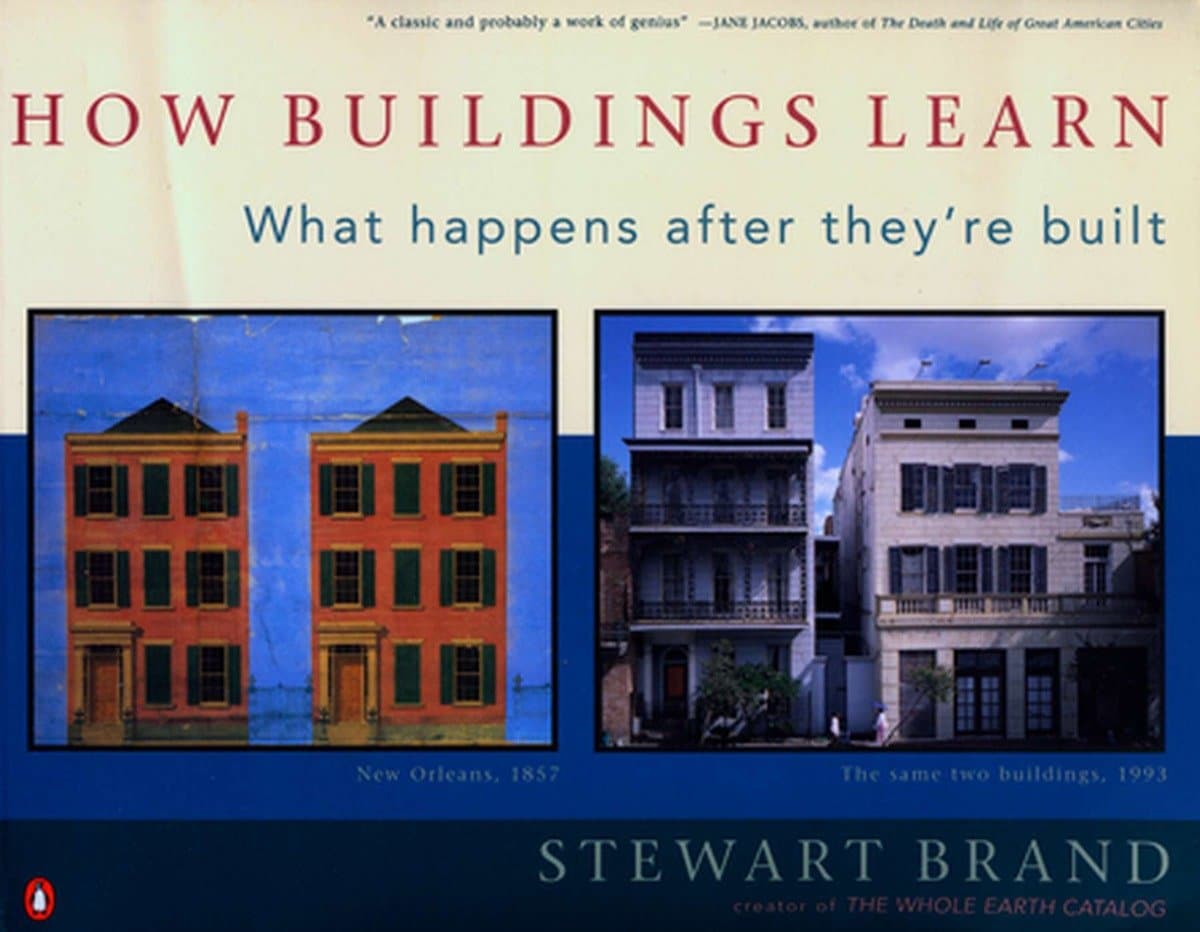
How Buildings Learn: What Happens After They’re Built
45.00 JOD
Please allow 2 – 5 weeks for delivery of this item
Description
A captivating exploration of the ever-evolving world of architecture and the untold stories buildings tell. When a building is finished being built, that isn’t the end of its story. More than any other human artifacts, buildings improve with time—if they’re allowed to. Buildings adapt by being constantly refined and reshaped by their occupants, and in that way, architects can become artists of time rather than simply artists of space. From the connected farmhouses of New England to I.M. Pei’s Media Lab, from the evolution of bungalows to the invention of Santa Fe Style, from Low Road military surplus buildings to a High Road English classic like Chatsworth—this is a far-ranging survey of unexplored essential territory.Discover how structures become living organisms, shaped by the people who inhabit them, and learn how architects can harness the power of time to create enduring works of art through the interconnected worlds of design, function, and human ingenuity.
Additional information
| Weight | 0.83 kg |
|---|---|
| Dimensions | 1.78 × 27.33 × 3.82 cm |
| Publication City/Country | USA |
| ISBN 10 | 0140139966 |
| About The Author | Though honored as a writerwith the National Book Award for the Whole Earth Catalog, Eliot Montroll Award for The Media Lab, Golden Gadfly Award for his years as editor of CoEvolution QuarterlySteward Brand is primarily an inventor/designer. Trained as a biologist and army officer, he was an early multimedia artist. He has created a number of lasting institutions, including New Games Tournaments, the Hackers Conference, and The WELL, a bellwether computer conference system. He is co-founder of Global Business Network, a futurist research organization fostering "the art of the long view." |
"It's about time somebody wrote this book. This quirky, thoughtful volume, bursting with curiosity and intelligence, may make our everyday world more visible to more Americans. Architecture is too important to be left to architects alone." Mixed Media"A stunning exploration of the design of design How Buildings Learn will irrevocably alter yor sense of place, space, and the artifacts that shape them." Michael Shrage, Wired"Penetratingly original." Philip Morrison, Scientific American"An extremely attractive volume that will forever alter the way we respond to the buildings around us. We may also hope it will alter the way architects design buildings." Harold Gilliam, San Francisco Chronicle"A fascinating and indefinable book How Buildings Learn is a hymn to entropy, a witty, heterodox book dedicated to kicking the stuffing out of the proposition that architecture is permanent and that buildings cannot adapt." Stephen Bayley, The Times (London)"The book's diagnosis is clear and to the poiny, and its illustrations of how buildings change are both fascinating and instructive. This is, in short, one of the rare books that every architect should read." Thomas Fisher, editor, Progressive Architecture"A book of good sound-bites and laser-sharp insight No architecture students should complete their preliminary studies without reading it from cover to cover." Patric Hannay, The Architects' Journal | |
| Table Of Content | AcknowledgmentsCover Story1. Flow2. Shearing Layers3. "Nobody Cares What You Do In There": The Low Road4. Houseproud: The High Road5. Magazine Architecture: No Road6. Unreal Estate7. Preservation: A Quiet, Populist, Conservative, Victorious Revolution8. The Romance of Maintenance9. Vernacular: How Buildings Learn from Each Other10. Function Melts Form: Satisficing Home and Office11. The Scenario-buffered Building12. Built for ChangeAPPENDIX: The Study of Buildings in TimeRecommended Bibliography: Books for Time-kindly BuildingsIndex |
Only logged in customers who have purchased this product may leave a review.
Related products
![]()
On backorder 2-5 Weeks to Arrive
![Lipstick on a Pig Winning In the No-Spin Era by Someone Who Knows the Game]()
On backorder 2-5 Weeks to Arrive
![Applebee's America How Successful Political, Business, and Religious Leaders Connect with the New American Community]()
On backorder 2-5 Weeks to Arrive
![Contrarian Investment Strategies The Psychological Edge]()
On backorder 2-5 Weeks to Arrive



Reviews
There are no reviews yet.