
Loading cart contents...
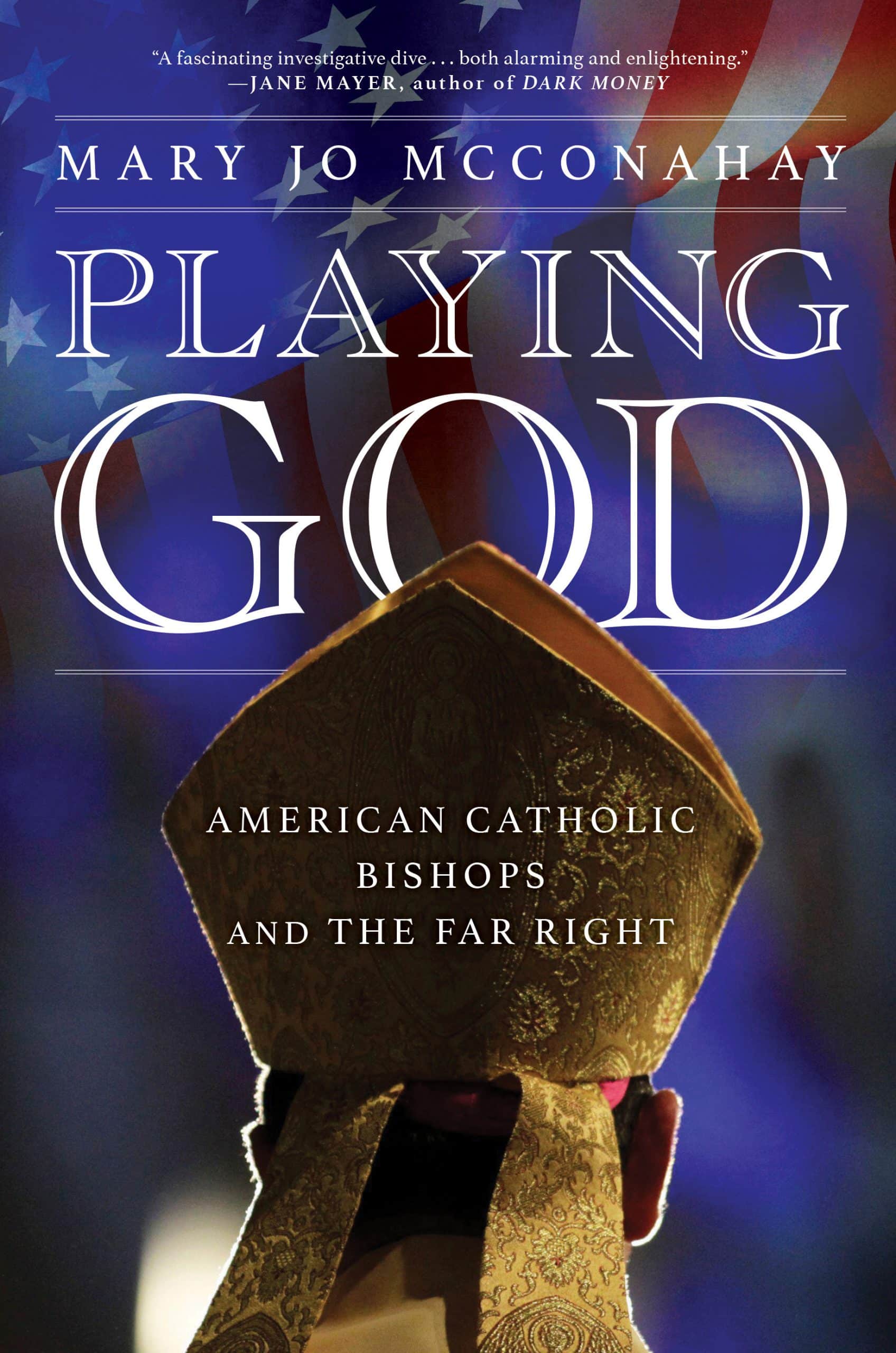
Playing God: American Catholic Bishops and The Far Right
29.99 JOD
Please allow 2 – 5 weeks for delivery of this item
Description
“A fascinating, investigative dive . . . both alarming and enlightening.” — Jane Mayer, author of Dark Money The definitive account of how a group of American Catholic bishops are using “dark money” and allying with ultra-right evangelicals in an attempt to remake America . . . Seasoned Catholic journalist and former war correspondent Mary Jo McConahay tells the story of how the United States Conference of Catholic Bishops have become one of the most formidable and reactionary forces in America — by campaigning to alter democratic institutions under the guise of religious liberty, and allying with major right-wing contributors such as the Kochs. In fact, many of the bishops—two-hundred and twenty-nine men, almost all white and beyond middle age—are such staunch opponents of Pope Francis that some US Catholics fear a schism with Rome. The influence of these bishops can be traced in recent news stories—such was when they maneuvered to deny the Eucharist to pro-choice politicians like President Biden. With their lay partners, the bishops also help shepherd cases into the Supreme Court that change the law of the land, as with Roe v. Wade. But as McConahay details, that’s just the tip of the iceberg. In an investigation reminiscent of Jane Mayer’s Dark Money, she uncovers an ominous and long-term political strategy of attacking secular, liberal democracy by waging war on democratic norms and institutions.
Additional information
| Weight | 0.49 kg |
|---|---|
| Dimensions | 2.54 × 15.88 × 4.21 cm |
| Pages | 288 |
| Language | |
| Format Old` | |
| Year Published | 2023-3-28 |
| Imprint | |
| Publisher | |
| by | |
| Publication City/Country | USA |
| ISBN 10 | 1685890288 |
| About The Author | Mary Jo McConahay is one of the most prominent Catholic journalists in America. In the 1980s she was a legendary war correspondent covering the Central American insurgencies. She is the author of three books, including The Tango War, The Struggle for the Hearts, Minds and Riches of Latin America During World War II, (starred reviews Kirkus, Publishers’ Weekly, Library Journal), and Maya Roads, One Woman’s Journey Among the People of the Rainforest (Northern California Book Awards Best Creative Nonfiction Book, National Geographic Traveler Book of the Month, Independent Publishers Award Best Travel Memoir). |
"Playing God is an important book…McConahay excels in lining out the players, the money flow, and their interaction with politics and beyond." — National Catholic Reporter"The conservative nature of the Catholic Church has long posed a challenge for postwar American Catholic liberals…McConahay admires Francis, who stands for the possibility that the church might gradually become, if not liberal, at least less conservative." — The New York Times"…comprehensive and unsparing indictment…persuasive…This is an intriguing and often distressing study of forces encroaching on the separation between church and state in America." — Publishers Weekly "[a] searching investigation…Dark money meets medieval thought in this intriguing expose of American Catholicism and its right discontents." — Kirkus Reviews"Playing God is a fascinating, investigative dive into a realm of politics that is too often overlooked: the increasingly reactionary figures who dominate American Catholicism. Mary Jo McConahay, a veteran reporter who is herself Catholic, reveals her co-religionists' deep-pocketed donors, detailing how they exert a rightward pull on both the church, and on American politics at large. The story she tells is both alarming and enlightening." — Jane Mayer, author of Dark Money: The Hidden History of the Billionaires Behind the Rise of the Radical Right. “American democracy helped inspire a Catholic reform at the Second Vatican Council. Now reactionary American Catholics who reject that reform quicken an assault on American democracy itself – and on authentic faith. No one has explained that paradox – that danger – better than Mary Jo McConahay. Her elegant deconstruction of this political and moral tragedy is convincing and deeply alarming. A book for every Catholic concerned for faith, and for every American concerned for democracy.” —James Carroll, author of The Truth at the Heart of the Lie “In clear-eyed prose and marshaling an army of facts, McConahay shows how radical Catholic clerics, political operatives, and businessmen have insinuated their reactionary beliefs into the mainstream. A must-read for all those who seek to understand why religious extremism is flourishing in America.” — Jake Bernstein, Pulitzer Prize-winning author of The Laundromat: Inside the Panama Papers Investigation of Illicit Money Networks and the Global Elite “A trenchant and necessary addition to the growing body of literature on religious extremism in the United States. Mary Jo McConahay, a concerned Catholic, shows how a cadre of conservative Catholic bishops have pushed the American Church away from the mainstream and the humane teachings of Pope Francis, and into the toxic operations of the Religious Right.” — Anne Nelson, author of Shadow Network: Media, Money, and the Secret Hub of the Radical Right “Through extraordinary research and eye-opening stories, McConahay offers a complex, comprehensive inquiry into the U.S. Catholic bishops’ support for Christian nationalism. Playing God is a provocative, prophetic and courageous work that speaks truth to power.” — Jean Molesky-Poz, Graduate Program of Pastoral Ministries faculty member, Santa Clara University, and author of Contemporary Maya Spirituality | |
| Excerpt From Book | The euphoria with which American Catholic bishops greeted the Supreme Court decision to overturn Roe v. Wade reflects how much the prelates claim the victory as their own. This was a victory fifty years in the making. The most conservative among the bishops will continue their efforts, in alliance with far-right Catholic laymen, like-minded evangelical Christians, and ultraright politicians, to implant a nationalist Christian dispensation in the law and culture of the United States, believing that their own moral point of view ought to reign for everybody, throughout the land. The posture of America’s Catholic bishops is important beyond the Church. They lead 73 million believers in the United States, more than a fifth of the population. Catholics vote (75 percent in 2016), and, since 1952, their vote usually goes to the winning presidential candidate. The active members of the United States Conference of Catholic Bishops (USCCB), 274 men, almost all beyond middle age and white, represent one of the most powerful lobbying groups in America, their Office of Government Relations charged with directing activities “to influence the actions of the Congress.” The bishops influence what goes on in every Catholic parish in America. But these days U.S. bishops do not reflect the global Catholic Church. As a group they are a particularly American species, hierarchical to a fault, and so traditionalist and politically right-wing that they are out of step with the current occupant of the Chair of St. Peter, Pope Francis. Named bishops by Pope John Paul II (1978–2005) or by Pope Benedict XVI (2005–2013), the majority of these bishops spotlight dissatisfaction with Francis by opposing him over issues such as whether politicians who support abortion may be denied Holy Communion—the right-wing bishops try to deny Communion to the likes of President Joe Biden and Nancy Pelosi, even though the pope has said he has never denied the Eucharist to anyone. As religious leaders of the wealthiest capitalist country on the planet, they are embarrassed by the pope’s full-throated criticism of unfettered capitalism, or they ignore it, a stand that is key to understanding the American bishops’ alliance with the monied far right, both Catholic and non-Catholic. They disagree with the pope that bishops should emphasize the importance of all pro-life issues, without calling abortion “preeminent” among them. The distance between the United States Conference of Catholic Bishops and the Vatican has placed the U.S. Church on the verge of schism. Pope Francis, elected in 2013, the first pope from Latin America, possesses an outgoing personality, is open to the press, and is enormously popular with many of the world’s 1.3 billion Catholics for his pastoral manner. He has declared that the landmark Second Vatican Council (1962–65), known as Vatican II, presents the Church’s ultimate teaching, including insistence that the Catholic Church is not defined by its hierarchy alone, but that laypeople, clergy, and bishops make up the People of God, who are the Church. He stands against reverting to pre–Vatican II customs and practices, such as the Traditional Latin Mass (TLM), a position with which ultraconservative American bishops disagree. Some of the U.S. bishops support the vision and priorities of Pope Francis, and many are faithful in letter and spirit to Vatican II. But so intransigent is the conservative majority, and so strong is the financial support for their positions from the wealthy, as well as from allies in political and legal spheres, that American Catholic prelates can be expected to continue to help spearhead the country’s rightward lurch toward nationalism and rule that reflects Christian values as only they see them. This remains true whether Pope Francis leaves the papal throne by resignation or in death. U.S. bishops want to insert their vision of Catholicism into aspects of law and society that go beyond religion. They really don’t want separation of church and state if their moral values are missing from politics and culture. Besides anti-abortion legislation and other limits on women’s freedom, the most ultraconservative bishops stand for traditional gender roles, and the most radical of their far-right allies promote laws that repress voting by African Americans and Latinos, with little vocal disapproval from the bishops. Members of the USCCB already control a significant part of the U.S. health system, with one in six hospitals nationwide (and 40 percent of hospitals in some states) run by Catholics and subject to directives codified by the bishops: no to contraception, to abortion (to a point that may put the health of miscarrying mothers at risk), to voluntary sterilization, certain hysterectomies and end of life directives, euthanasia, physician-assisted suicide, and gender-affirming care (for transgender people). The bishops’ views align with those of the six members of the conservative majority of the U.S. Supreme Court, all of whom were raised Catholic. This book examines the teaching and public witness of the U.S. Catholic bishops, where they converge with pivotal figures of the far right, and looks at Catholic lay rightists who have been key in partnering with right-wing evangelical Christians in a fifty-year, precisely orchestrated campaign to shape the country into a Christian nation that conforms to their moral views. It looks at the bishops’ wealthy corporate and industrial supporters, like Charles Koch and Tim Busch, who fund the far-right vision under the guise of pursuing civic and religious freedoms; they spend billions on the idea of a supremely free market nation without safety, environment, and labor regulation or guarantees for groups that offend their radical Christian sensibilities, like LGBTQ+ people. The book shows the role of the most conservative bishops in what they have done or failed to do, in undermining national priorities like fighting the COVID-19 pandemic and combatting the environmental crisis—chipping away at government authority is a hallmark of surging Christian nationalism. And the book looks at important Catholic legal figures, like Justice Clarence Thomas and Federalist Society cofounder Leonard Leo, who have rendered the wall between church and state a mere gossamer curtain, the better for their version of Christian morality to rule the land. I have no animus toward the Catholic Church or its bishops. As a lifelong Catholic, including years reporting from Latin America, I have seen the extent to which my coreligionists have gone, including bishops, even to the point of martyrdom, on behalf of other people, and of justice. At the same time, I have always believed the institution of the Church was worth investigation and critique. Like other Americans, I was shaken by the events of January 6, 2021. I saw those hours through the eyes and ears of a reporter who has covered war, religion, and politics, both at home and in autocracies abroad. Now, in my own nation’s capital, I watched in horror and disbelief at one man’s exhortation to loyalists to rise up and march with him to upturn the law. I saw crosses and Bibles side by side with Confederate flags, nooses, and other symbols of white supremacy connected with ultraright Christianity and Christian nationalism. I tracked the reactions of people on social media and in the alt-right press, including multiple far-right Catholic outlets. I saw how they conflated the figure of a strongman—in this case, Donald Trump, who disdains democratic norms—with Jesus Christ. How the extremists among my coreligionists exuded a sense of embattled Christianity, expressed in comparisons of supposedly repressed U.S. believers with Jews killed by Hitler. As a reporter, indeed as a Catholic, I felt it was time to look at the U.S. Church as a key institution playing an outsize role in the current, dangerous political moment. |
Only logged in customers who have purchased this product may leave a review.
Related products
![]()
On backorder 2-5 Weeks to Arrive
![]()
On backorder 2-5 Weeks to Arrive
![]()
On backorder 2-5 Weeks to Arrive
![]()
On backorder 2-5 Weeks to Arrive
Reviews
There are no reviews yet.