
Loading cart contents...
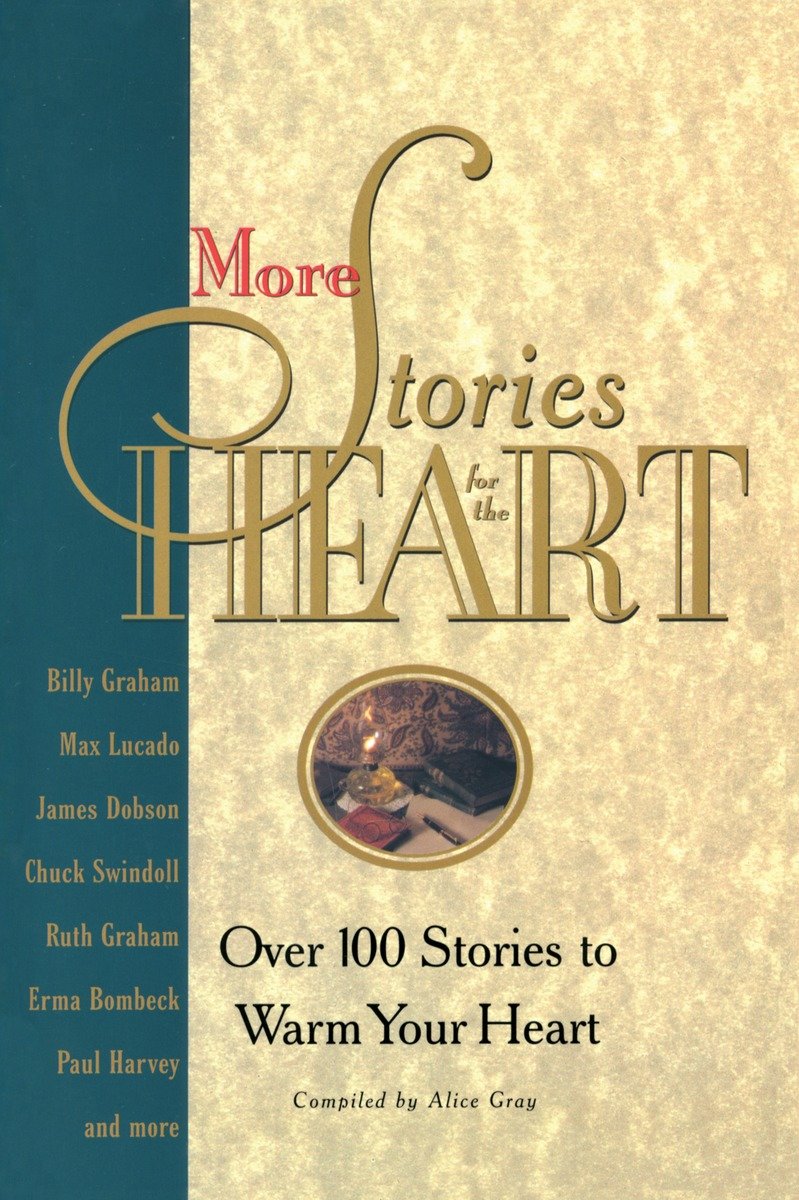
The Second Collection: More Stories for the Heart
16.99 JOD
Please allow 2 – 5 weeks for delivery of this item
Description
A sequel to Stories for the Heart, More Stories for the Heart offers up over one hundred stories that hug readers’ hearts and encourage their souls. This treasury of timeless tales-written by some of the best Christian communicators today-offers a wealth of compassion and love certain to minister to multiple generations. Readers will find themselves sharing these uplifting tales in conversation and letting the stories’ wisdom inspire their thinking. These are stories that will add flavor to readers’ views…and will be carried in their hearts. Whether read during peaceful moments spent cuddled up by the fire, during moments basking in the sunshine…or during read-aloud family times with loved ones, More Stories for the Heart is certain to encourage the soul.
Additional information
| Weight | 0.3632 kg |
|---|---|
| Dimensions | 1.905 × 13.97 × 21.59 cm |
| Language | |
| Format Old` | |
| Publisher | |
| Imprint | |
| Year Published | 1997-7-1 |
| series | |
| by | |
| Publication City/Country | USA |
| ISBN 10 | 1576731421 |
| About The Author | Alice Gray is an inspirational conference speaker and the creator and compiler of the bestselling Stories for the Heart book series, with more than 5 million in print. She and her husband, Al, live in Arizona. |
| Excerpt From Book | The Day Philip Joined the GroupPAUL HARVEY with acknowledgement to Rev. Harry Pritchett Jr., rector of All Saints Episcopal Church in Atlanta, who called my attention to a boy named Philip.He was 9—in a Sunday school class of 8-year-olds.Eight-year-olds can be cruel.The third-graders did not welcome Philip to their group. Not just becausehe was older. He was “different.”He suffered from Down’s syndrome and its obvious manifestations:facial characteristics, slow responses, symptoms of retardation.One Sunday after Easter the Sunday school teacher gathered some ofthose plastic eggs that pull apart in the middle—the kind in which someladies’ pantyhose are packaged.The Sunday school teacher gave one of these plastic eggs to eachchild.On that beautiful spring day each child was to go outdoors and discoverfor himself some symbol of “new life” and place that symbolic seedor leaf or whatever inside his egg.They would then open their eggs one by one, and each youngsterwould explain how his find was a symbol of “new life.”So…The youngsters gathered ’round on the appointed day and put theireggs on a table, and the teacher began to open them.One child had found a flower.All the children “oohed” and “aahed” at the lovely symbol of new life.In another was a butterfly. “Beautiful,” the girls said. And it’s not easyfor an 8-year-old to say “beautiful.”Another egg was opened to reveal a rock. Some of the childrenlaughed.“That’s crazy!” one said. “How’s a rock supposed to be like a ‘newlife’?”Immediately a little boy spoke up and said, “That’s mine. I kneweverybody would get flowers and leaves and butterflies and all that stuff,so I got a rock to be different.”Everyone laughed.The teacher opened the last one, and there was nothing inside.“That’s not fair,” someone said. “That’s stupid,” said another.Teacher felt a tug on his shirt. It was Philip. Looking up he said, “It’smine. I did do it. It’s empty. I have new life because the tomb is empty.”The class fell silent.From that day on Philip became part of the group. They welcomedhim. Whatever had made him different was never mentioned again.Philip’s family had known he would not live a long life; just too manythings wrong with the tiny body. That summer, overcome with infection,Philip died.On the day of his funeral nine 8-year-old boys and girls confrontedthe reality of death and marched up to the altar—not with flowers.Nine children with their Sunday school teacher placed on the casketof their friend their gift of love—an empty egg.A Song in the DarkMAX LUCADO, from God Came NearOn any other day, I probably wouldn’t have stopped. Likethe majority of people on the busy avenue, I wouldhardly have noticed him standing there. But the very thing on my mindwas the very reason he was there, so I stopped.I’d just spent a portion of the morning preparing a lesson out of theninth chapter of John, the chapter that contains the story about the manblind from birth. I’d finished lunch and was returning to my office whenI saw him. He was singing. An aluminum cane was in his left hand; hisright hand was extended and open, awaiting donations. He was blind.After walking past him about five steps, I stopped and mumbledsomething to myself about the epitome of hypocrisy and went back in hisdirection. I put some change in his hand. “Thank you,” he said and thenoffered me a common Brazilian translation, “and may you have health.”Ironic wish.Once again I started on my way. Once again the morning’s study ofJohn 9 stopped me. “Jesus saw a man, blind from birth.” I paused andpondered. If Jesus were here he would see this man. I wasn’t sure whatthat meant. But I was sure I hadn’t done it. So I turned around again.As if the giving of a donation entitled me to do so, I stopped beside anearby car and observed. I challenged myself to see him. I would stay hereuntil I saw more than a sightless indigent on a busy thoroughfare indowntown Rio de Janeiro.I watched him sing. Some beggars grovel in a corner cultivating pity.Others unashamedly lay their children on blankets in the middle of thesidewalk thinking that only the hardest of hearts would ignore a dirty,naked infant asking for bread.But this man did none of that. He stood. He stood tall. And he sang.Loudly. Even proudly. All of us had more reason to sing than he, but hewas the one singing. Mainly, he sang folk songs. Once I thought he wassinging a hymn, though I wasn’t sure.His husky voice was out of place amid the buzz of commerce. Like asparrow who found his way into a noisy factory, or a lost fawn on an interstate,his singing conjured up an awkward marriage between progress andsimplicity.The passersby had various reactions. Some were curious and gazedunabashedly. Others were uncomfortable. They were quick to duck theirheads or walk in a wider circle. “No reminders of harshness today, please.”Most, however, hardly noticed him. Their thoughts were occupied, theiragendas were full and he was…well, he was a blind beggar.I was thankful he couldn’t see the way they looked at him.After a few minutes, I went up to him again. “Have you had anylunch?” I asked. He stopped singing. He turned his head toward thesound of my voice and directed his face somewhere past my ear. His eyesockets were empty. He said he was hungry. I went to a nearby restaurantand bought him a sandwich and something cold to drink.When I came back he was still singing and his hands were still empty.He was grateful for the food. We sat down on a nearby bench. Betweenbites he told me about himself. Twenty-eight years old. Single. Living withhis parents and seven brothers. “Were you born blind?”“No, when I was young I had an accident.” He didn’t volunteer anydetails and I didn’t have the gall to request them.Though we were almost the same age, we were light-years apart. Mythree decades had been a summer vacation of family excursions, Sundayschool, debate teams, football, and a search for the Mighty One. Growingup blind in the Third World surely offered none of these. My daily concernnow involved people, thoughts, concepts, and communication. Hisday was stitched with concerns of survival: coins, handouts, and food. I’dgo home to a nice apartment, a hot meal, and a good wife. I hated to thinkof the home he would encounter. I’d seen enough overcrowded huts onthe hills of Rio to make a reasonable guess. And his reception…wouldthere be anyone there to make him feel special when he got home?I came whisker-close to asking him, “Does it make you mad that I’mnot you?” “Do you ever lie awake at night wondering why the hand youwere dealt was so different from the one given a million or so others bornthirty years ago?”I wore a shirt and tie and some new shoes. His shoes had holes and hiscoat was oversized and bulky. His pants gaped open from a rip in the knee.And still he sang. Though a sightless, penniless hobo, he still founda song and sang it courageously. (I wondered which room in his heart thatsong came from.)At worst, I figured, he sang from desperation. His song was all he had.Even when no one gave any coins, he still had his song. Yet he seemed toopeaceful to be singing out of self-preservation.Or perhaps he sang from ignorance. Maybe he didn’t know what hehad never had.No, I decided the motivation that fit his demeanor was the one you’dleast expect. He was singing from contentment. Somehow this eyelesspauper had discovered a candle called satisfaction and it glowed in hisdark world. Someone had told him, or maybe he’d told himself, thattomorrow’s joy is fathered by today’s acceptance. Acceptance of what, atleast for the moment, you cannot alter.I looked up at the Niagara of faces that flowed past us. Grim.Professional. Some determined. Some disguised. But none were singing,not even silently. What if each face were a billboard that announced thetrue state of the owner’s heart? How many would say “Desperate! Businesson the rocks!” or “Broken: In Need of Repair,” or “Faithless, Frantic, andFearful”? Quite a few.The irony was painfully amusing. This blind man could be the mostpeaceful fellow on the street. No diploma, no awards, and no future—atleast in the aggressive sense of the word. But I wondered how many in thaturban stampede would trade their boardrooms and blue suits in a secondfor a chance to drink at this young man’s well.“Faith is the bird that sings while it is yet dark.”Before I helped my friend back to his position, I tried to verbalize myempathy. “Life is hard, isn’t it?” A slight smile. He again turned his facetoward the direction of my voice and started to respond, then paused andsaid, “I’d better get back to work.”For almost a block, I could hear him singing. And in my mind’s eye Icould still see him. But the man I now saw was a different one than theone to whom I’d given a few coins. Though the man I now saw was stillsightless, he was remarkably insightful. And though I was the one witheyes, it was he who gave me a new vision. |
Only logged in customers who have purchased this product may leave a review.
Related products
![woocommerce-placeholder-558x558.png]()
On backorder 2-5 Weeks to Arrive
16.99 JOD![Visibly Muslim]()
On backorder 2-5 Weeks to Arrive
28.99 JOD![woocommerce-placeholder-558x558.png]()
On backorder 2-5 Weeks to Arrive
4.99 JOD![woocommerce-placeholder-558x558.png]()
On backorder 2-5 Weeks to Arrive
5.99 JOD


Reviews
There are no reviews yet.