
Loading cart contents...
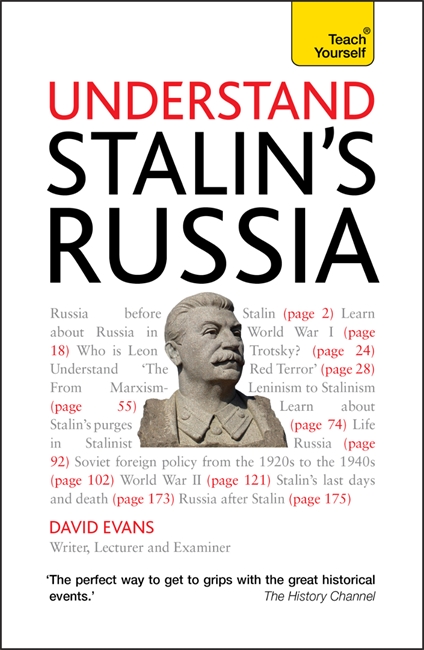
Understand Stalin’s Russia: Teach Yourself
10.99 JOD
Please allow 2 – 5 weeks for delivery of this item
Add to Gift RegistryOnly logged in customers who have purchased this product may leave a review.
Description
Additional information
| Weight | 0.178 kg |
|---|---|
| Dimensions | 1.4 × 13.2 × 19.7 cm |
| Format | |
| language1 | |
| Pages | 208 |
| Publisher | |
| Year Published | 2012-2-24 |
| Imprint | |
| Publication City/Country | London, United Kingdom |
| ISBN 10 | 1444157566 |
| About The Author | David Evans is an established writer and lecturer. He has written over twenty books on modern European history, and appears regularly on television and radio |
| Other text | "The perfect way to get to grips with the great historical events." – The History Channel. |
| Table Of Content | : Introduction: 1. Russia at the time of Stalin's birth: 2. Towards revolution: The Russia into which Stalin was born: The condition of Russia in 1879 (the year of Stalin's birth): 3. Civil war, the death of Lenin and the power struggle: 4. The collectivization of agriculture: The church, class structure and the autocratic rule of the Romanovs: The condition of the Russian people: 5. The Five-Year Plans: 6. From Marxism-Leninism to Stalinism: The development of a revolutionary tradition: Towards revolution and civil war: 7. Stalin's terror: 8. Everyday life in Stalin's Russia: Political parties and revolutionary groups: Tsarism under threat: The reasons for its survival and recovery: 9. Soviet foreign policy, 1918-40: 10. The Great Patriotic War, 1941-5: The age of the dumas: Russia's involvement in the First World War and its consequences: 11. Soviet foreign policy after 1945 – The Cold War: 12. The final years of Stalin's rule: Background to the revolutions of 1917: The failure of the Provisional Government and the coming of civil war: 13. Stalinist Russia – a postscript: The end of the Romanovs: The death of Lenin and the power struggle: The significance and aftermath of Lenin's death: The power struggle – Stalin versus Trotsky: The stages of the power stuggle: The reasons for Stalin's success: Collectivization and Five Year Plans – Stalin's economic policies: Lenin's new economic policy abandoned: The process of the collectivization of agriculture: The fate of the kulaks: Collectivization – success or failure?: The industrialization of Russia – Five Year Plans: Five Year Planning – success or failure?: The impact of Stalin's economic policies on the Russian people: Stalin's Russia: The meaning of Stalinism: The new constitution of 1936: The education system and youth movements: Zhenotdel and the role of women in Soviet society: Stalin's policy regarding the Church and religion: The arts and a cultural revolution: The terror and the purges: Various episodes – the Shakhty trials, the Riutin affair and the assassination of Sergei Kirov: Purges, show trials and their victims: The roles of Vyshinsky and Beria: The assassination of Trotsky: Stalin's foreign policy: Attitudes to Russia after the First World War: The Third International and the Communist International – Comintern: Soviet diplomacy in the 1920s: Relations with other world powers and involvement in the Far East: The Anti-Comintern Pact and Stalin's search for collective security: Involvement in the Spansih Civil War: Soviet attitude to the Czech crisis of 1938: The Ribbentrop-Molotov Pact, 1939 and its purpose: 'The Winter War' against Finland: 'The Great Patriotic War' – the Soviet Union and the Second World War: 'Operation Barbarossa': Reasons for Hitler's decision to invade the Soviet Union in 1941: The treatment of the Soviet people during the years of German occupation: Collaboration and resistance: The course of the war: The significant battles and turning points of the war: An estimate of Stalin as a wartime leader: The Soviet contribution to the final Allied victory: Soviet foreign policy and the coming of the Cold War: Post-war conferences, Yalta and Potsdam: The division of German and the Soviet Union's territorial gains: The collapse of the wartime alliance: The imposition of Communist rule over Eastern Europe: The 'iron curtain' and the impact of the Truman Doctrine and Marshall Plan: Berlin (1948) and other crises in East-West relations: The Soviet Union becomes a nuclear power: The final years of Stalin's rule: Post-war reconstruction in the Soviet Union: Stalinist tyranny intensifies: Zhdanovism and the purge of Soviet culture: Stalin's 'cult of personality': Anti-Semitism and the 'Doctor's Plot': An end of an era – the death of Josef Stalin |
Related products
![]()
On backorder 2-5 Weeks to Arrive
Add to Gift Registry10.99 JOD![]()
On backorder 2-5 Weeks to Arrive
Add to Gift Registry32.99 JOD![]()
On backorder 2-5 Weeks to Arrive
Add to Gift Registry![]()
On backorder 2-5 Weeks to Arrive
Add to Gift Registry18.99 JOD

Reviews
There are no reviews yet.